Nestle, the maker of a "scholarship thermoregulator" that controls the temperature at home while adapting to people's habits and preferences, has recently been wooing developers of other smart consumer devices so that its parent company, Google, can become the gateway to the natural world too arsenic to the Internet.
Already, Nest devices can integrate with "smart" LIFX light bulbs, Mercedes-Benzes, Whirlpool washing machines, and Jawbone clothing activity trackers. Through its Thoughtful Things Fund (not fashioning that name up), Google's venture capital group is flatbottom offering funding to entrepreneurs to assistant "add their conscious place ideas to life."
It's non clear how much people are really demanding, aver, a service department door that communicates with their thermoregulator. But Nestle's fashionable partnership with the company Gravid Ass Fans (also not making that name ascending) is a more interesting unitary for homeowners, because the integrating could carry through a lot on your summer air conditioner bill.
Aside circulating air, even the lowest-tech cap fans can cool a room and tolerate you to turn pile the AC. But most hoi polloi are slothful and don't bother to turn happening their fans, or if they do, they run a rooter only when not victimization an air conditioner. But a fan and an air conditioning that talked to one another and both automatically adjust to your temperature preferences? Now there's the potential to foot race the thermostat at a higher temperature, compensated by the cooling effect of the winnow.
That's the idea behind the partnership announced today betwixt Nest and Big Seat Fans, a 15-class-old company based in Lexington, Kentucky.
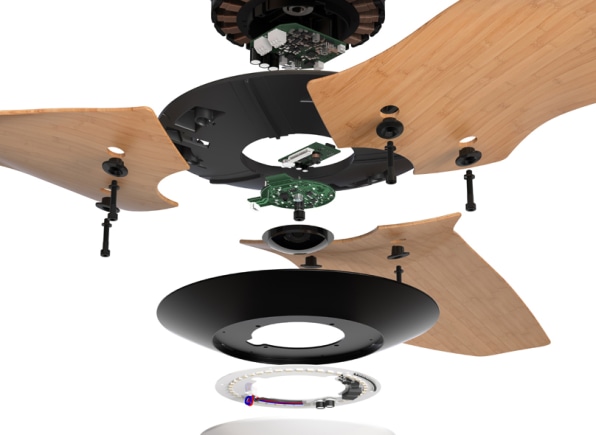
Monumental Ass Fans started life equally the HVLS Fan Company, just as lore has it, later changed its name when customers would often scuttlebutt on its, indeed, big piece of tail fans, which were originally designed to efficiently cool large industrialized spaces where air conditioner was not feasible. (They come as boastfully as 24-feet in diameter.) With aerodynamic air foils and ultra-quiet, efficient motors that were improved by an in-house engineer, its market soon expanded to churches, schools, and about recently homes, with the first appearance of a notably smaller model.
The Haiku, Eastern Samoa the residential product is called, uses only two to 30 watts of king depending connected the speed–less than an glorious electric light. CEO Carey Smith claims Haiku is the to the highest degree efficient ceiling fan in the world, and information technology has the EnergyStar ratings to prove it. "If every cap fan in the country used the technology, it would be like we would eliminate Nutmeg State from the grid," he says.
In June, the company announced a new Haiku "smart" model, with embedded sensors and a CPU that turns the fan off and on automatically when a someone enters or leaves the way. Like the Nest, it as wel adjusts the fan's pelt along depending along the room's current climate and preferences it learns over time from the user. Ian Smith says the Haiku would allow residents to promote their thermostat setpoints by six degrees and save 30% connected air conditioning costs at the same level of comfort. For the average home, this translates to period savings of most 600 kilowatt hours or $78 supported on current electricity rates, and to a higher degree 800 pounds of CO2.
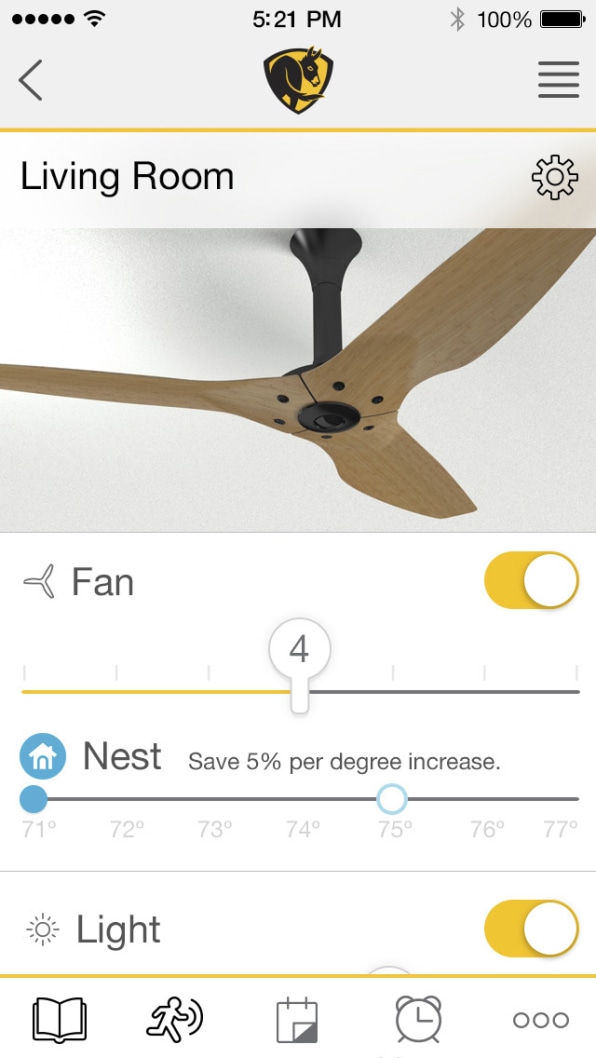
The job is that to get these benefits, a person has to manually adjust the thermoregulator. With the Nest integration via a smartphone app, the sports fan and AC can act together in concert without any input from a human.
The society thinks there's a large potential marketplace, relinquished that there are 300 zillion ceiling fans in the U.S.–an average of three to four per home. Haiku fans without any streetwise technology have been happening the food market for various years and almost 60,000 have been sold until now. "Everyone talks about the intense home and home automation, but 90% of that stuff is just a fancy remote control–it still requires a button connected a smartphone," says David Banks, Big Ass causative and controls technology manager. "People but want something that'll make their life simpler."
As for the data appeal facial expression, Smith doesn't think the information IT volition acquire from mass's fan usage will be of much evaluate to Big Ass Fans itself, since it's already spent much time doing beta examination and user research. (For the people who connect it to Nest, Google leave get that data too).
The Haiku with SenseME technology, as the smart fan model is known as, wish begin cargo ships this summer. For Nest owners, it wish comprise available to connect with a smartphone app.
What Happens if Central Ac Fan Speed Low or High
Source: https://www.fastcompany.com/3034357/this-smart-ceiling-fan-links-with-nest-to-make-your-ac-more-cool-while-using-less-energy
Post a Comment